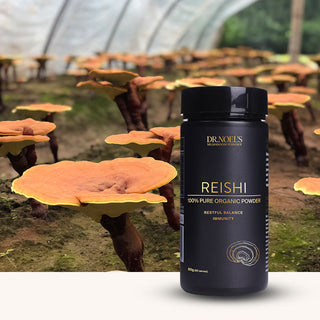


Reishi polysaccharide peptides, often shortened to GLPP, are carbohydrate-rich compounds studied in Ganoderma lucidum. Their names describe aspects of their chemistry; they do not establish a health benefit. Understanding the particular preparation and the type of experiment is essential when reading this research.
Structural studies have identified several different reishi glycopeptides. Laboratory findings have encouraged further investigation, while the human evidence remains limited. A placebo-controlled trial published in 2026 found no significant benefit on its measured inflammatory and metabolic outcomes. [6]
What does polysaccharide peptide mean?
A polysaccharide is a chain of linked sugar units. A peptide is a chain of amino acids. Researchers use terms such as polysaccharide peptide and glycopeptide for preparations containing both components. To understand a specific compound, they examine its sugar composition, molecular size, branching and peptide component.
For example, a 2019 study isolated a fraction called GL-PPSQ2 from a reishi water extract. Its measured molecular weight was about 50 kilodaltons (kDa), its sugars were mainly glucose with some mannose, and its amino acid content was approximately 5%. The researchers also mapped a branched carbohydrate structure. These measurements describe that isolated fraction rather than a universal formula for every reishi extract. [1]
Why the exact preparation matters
Another research fraction, GL-PWQ3, had a reported molecular weight of about 24 kDa and contained mainly glucose and galactose. A separate preparation used in a 2015 animal study was approximately 500 kDa, with a reported carbohydrate-to-peptide ratio of about 95:5. [2] [3]
These examples show why results need to stay attached to the material actually tested. Sharing the name “reishi” or the abbreviation “GLPP” does not establish that two preparations have the same composition or effects.
Hot-water extraction was part of the isolation process for GL-PPSQ2 and GL-PWQ3, followed by additional separation and purification. A water extract on a label therefore does not identify a purified research fraction. Likewise, obtaining a compound using hot water does not establish that every preparation retains the same structure or activity under every heating condition. [1] [2]
What laboratory studies can tell us
The GL-PWQ3 study reported antioxidant activity in cultured NRK-52E cells. This helps researchers investigate how a defined preparation behaves in an experimental setting; it does not establish a clinical effect after someone consumes a reishi product. [2]
The 2015 study examined GLPP in mice with experimentally induced kidney ischemia-reperfusion injury, alongside cell experiments. Researchers reported changes in kidney injury measures, oxidative stress and pathways associated with cell death. These are preclinical findings. They cannot establish that a retail supplement prevents kidney injury in people. [3]
What has been studied in people?
A 2018 paper followed 37 people at high cardiovascular risk and 34 people with stable angina for 90 days. It reported changes in several blood markers, including a reduction in malondialdehyde, a marker associated with oxidative damage. Superoxide dismutase increased significantly in the stable-angina group but not in the high-risk group. [4]
The study had no control group. Other medicines and changes over time could therefore have influenced the results. Measuring biomarkers also does not establish fewer heart attacks or improved long-term health. This study is useful preliminary evidence, but it cannot demonstrate that the preparation caused the observed changes. [4]
A 2023 randomized, double-blind placebo-controlled study included 62 people with cardiometabolic syndrome and reported favorable changes in two oxidative-stress markers after 60 days. However, the results text emphasizes changes within each group, and reporting does not fully clarify the between-group analysis. Its small sample and biomarker focus limit the conclusions about health benefits. [5]
A newer double-blind, randomized, placebo-controlled trial tested a different set of outcomes. Published in June 2026, it included 60 people with obesity and cardiometabolic syndrome. After eight weeks, there were no statistically significant differences between GLPP and placebo in the measured inflammatory markers, nitric oxide, blood lipids or body mass index. [6]
The 2026 trial was small and short, and its outcomes differed from the earlier oxidative-stress studies. It does not resolve every question about GLPP, but it did not demonstrate benefit for the outcomes it tested.
Three questions to ask about a reishi claim
- What was tested? Look for the named fraction, its composition and how it was prepared.
- Who or what was studied? Separate cell and animal experiments from human studies, and check whether a suitable control group was included.
- What actually changed? A laboratory marker, a symptom and a long-term health outcome answer different questions.
GLPP research offers a useful view into reishi chemistry. Its practical lesson is to read beyond the ingredient name and keep conclusions proportional to the evidence. The studies discussed here do not establish benefits for an untested commercial reishi product.
This article is educational and is not a treatment recommendation. Do not use it to replace prescribed care or make changes to medical treatment.
References
- Lin D-M, Luo H-J, Wang S-Z, et al. Structure and application of Ganoderma polysaccharide peptide GL-PPSQ2. Chinese Traditional and Herbal Drugs. 2019;50(2):336-343. Read the journal abstract. DOI: 10.7501/j.issn.0253-2670.2019.02.011.
- Luo H-J, Zhang Y-K, Wang S-Z, et al. Structural characterization and anti-oxidative activity for a glycopeptide from Ganoderma lucidum fruiting body. International Journal of Biological Macromolecules. 2024;261(Pt 2):129793. Read the abstract. DOI: 10.1016/j.ijbiomac.2024.129793.
- Zhong D, Wang H, Liu M, et al. Ganoderma lucidum polysaccharide peptide prevents renal ischemia reperfusion injury via counteracting oxidative stress. Scientific Reports. 2015;5:16910. Read the study. DOI: 10.1038/srep16910.
- Sargowo D, Ovianti N, Susilowati E, et al. Indian Heart Journal. 2018;70(5):608-614. Read the full paper. DOI: 10.1016/j.ihj.2017.12.007.
- Wardhani SP, Nadliroh KA, Aishaqeena AMF, et al. Ganoderma lucidum Polysaccharide Peptide Reduces Oxidative Stress and Improves Renal Function in Patient with Cardiometabolic Syndrome. The Indonesian Biomedical Journal. 2023;15(2):187-193. Read the paper. DOI: 10.18585/inabj.v15i2.2137.
- Abshori NF, Wardhani S, Fatoni F, et al. Current Drug Discovery Technologies. Published online June 16, 2026. Read the abstract. DOI: 10.2174/0115701638439377260608201603.