

A beta-glucan percentage tells us how much of a measured component a powder contains. It does not describe the size or structure of every molecule in that component. For anyone comparing reishi extracts, that distinction helps explain why one number cannot answer every quality question.
A 2026 study of acidic reishi beta-glucans offers a particularly useful example. Three purified fractions behaved differently in laboratory tests, and the result depended on what the researchers measured. We think the most useful lesson for shoppers is how to interpret a specification without asking it to prove more than it can.
What molecular weight adds to the picture
Beta-glucans are chains of glucose units. Their molecular weight describes molecular size, commonly reported in kilodaltons, or kDa. The way those units connect and branch also helps define the material. A percentage by weight and a molecular-weight measurement therefore answer different questions: how much is present, and what kind of molecules make up that amount?
The study by Wu and colleagues, published in Food Research International, examined three acidic beta-glucan fractions isolated from Ganoderma lucidum fruiting bodies. “Acidic” describes chemical features of these polysaccharides, including glucuronic acid; it is not a statement about how a reishi drink tastes. The fractions were separated research materials, rather than jars of retail reishi powder. Read the published research abstract.
| Fraction | Apparent molecular weight | Position in this comparison |
|---|---|---|
| GLP-2a | 15.57 kDa | Largest |
| GLP-2b | 7.49 kDa | Intermediate |
| GLP-2c | 4.69 kDa | Smallest |
These values come from the research team's report at the Kunming Institute of Botany. They describe this experiment. They do not establish an ideal molecular-weight range for every reishi supplement.
There was no single winner on every measure
The researchers used UV-stressed HaCaT cells, an established human skin-cell line grown in a laboratory. GLP-2b, the intermediate fraction, gave the stronger responses for several measures of oxidative stress. These included glutathione peroxidase activity, the lipid-peroxidation marker malondialdehyde and intracellular reactive oxygen species.
But the institute's report identifies a different pattern for superoxide dismutase, another antioxidant-enzyme measure: the larger and smaller fractions produced greater increases on that endpoint. That matters. Choosing one favourable result and calling a fraction universally “best” would hide part of the comparison.
We would read a claim such as “smaller beta-glucans always work better” with the same care as the opposite claim. Within this small set of related fractions, performance did not follow a simple bigger-is-better or smaller-is-better rule. Molecular size belongs alongside structure, preparation and the particular test being used.
The published abstract also compares GLP-2b with a hydrolysis-derived fraction of similar size. Their reactive-oxygen-species responses were comparable despite some differences in linkage composition. This is another reason to resist reducing a complicated ingredient to one structural feature.
Antioxidant activity in cells is a research result
These experiments help researchers identify materials worth investigating further. They do not show what happens after a person swallows a reishi powder. Cells exposed to a purified fraction in a dish are a different setting from digestion, metabolism and exposure within the body.
Nor does a UV-stressed skin-cell experiment establish a sunscreen effect, visible anti-ageing results or a reason to change sun protection. No human oral trial is described in the published abstract. We cannot use these findings to assign a clinical benefit to an untested commercial extract.
Reading our own reishi specification
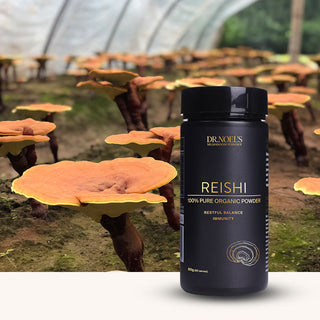
Our Organic Reishi Mushroom Extract Powder is a dual extract made from 100% fruiting bodies. Its current published specification lists at least 15% polysaccharides and at least 10% 1,3:1,6 beta-D-glucans, with no added starch, mycelium or fillers.
For a percentage explicitly reported on a weight-for-weight basis, 10% corresponds to 100 mg in 1 g on that same reporting basis. This illustrates the units; it does not establish a newly measured amount for a particular batch or a recommended dose. Our current public specification does not explicitly identify whether its percentage uses an as-sold or dry-matter basis, so we would confirm that detail before making a precise comparison.
The 15% polysaccharide and 10% beta-glucan figures should not be added to produce “25% actives”. Beta-glucans are themselves polysaccharides. The two specifications are not a statement that these are separate, non-overlapping ingredients.

Neither figure tells us the molecular-weight distribution of our extract or establishes that it contains GLP-2b at a studied concentration. We do not publish those measurements on the current product page, and this paper did not test our product. Clear ingredient information is useful precisely because we can distinguish what it establishes from what remains unknown.
What is worth comparing before you buy?
If your question is how much beta-glucan a product specifies, compare the stated units and ask which analytical method was used. If the claim concerns a particular research fraction, ask whether the finished product has actually been characterised for that fraction. These are different requests, and a total percentage cannot stand in for both.
Extraction ratios answer another question again. A raw-material equivalent describes a relationship between starting material and extract; it does not supply a molecular-weight profile. Our guide to extract weight and raw equivalents explains how to keep those numbers separate.
For our reishi, the practical starting point is a named fruiting-body ingredient, a stated preparation and published composition information. Explore Dr Noel's Organic Reishi Extract and read its current specifications if that is the kind of product you are comparing. A new laboratory finding should make the questions more precise, rather than turn a promising fraction into an unsupported promise on a jar.
If you are considering a supplement while taking medicines or managing a health condition, discuss the product with your doctor or pharmacist and follow the label.
Sources and reading scope
- Wu Z, Liu X, Luo Y, Quan C, Peng X, Qiu M. Novel acidic β-glucans from Ganoderma lucidum: Structural characterization and molecular-weight-related antioxidant activity. Food Research International. 2026;242(Pt 5):120192. Published abstract reviewed.
- Kunming Institute of Botany, Chinese Academy of Sciences. Institutional report on reishi polysaccharide structure and UV-stressed cell research, 2 September 2026 (Chinese). Relevant report read in full.
Editorial starting point: a Chinese research explainer supplied by a reader, published by Junwu Jiankang (菌物健康) on 9 October 2026. This is our original interpretation, checked against the published abstract and the research team's report. The full journal methods were not available for this review. Product specifications checked on 5 November 2026.